
 In twenty years of chasing leaks across Bukit Timah, Holland Village, Siglap and the Ridout enclave, I’ve learned one thing landed homeowners rarely hear from a sales-first contractor: most roof failures aren’t material failures, they’re system failures.
A torch-on membrane doesn’t fail because the product is bad — it fails because nobody primed the substrate properly, or the flashing detail was an afterthought. These waterproofing tips landed house Singapore owners actually need come from years of tearing off botched “quick fix” coatings and doing the job over, properly, on GCBs and terrace houses alike.
Whether you’re maintaining a GCB in Bukit Timah or a terrace house in Serangoon Garden, the physics is identical: Singapore’s heat, humidity, and monsoon volume expose weak workmanship fast. A terrace house waterproofing job carries one extra wrinkle a detached bungalow doesn’t — shared party walls and a roofline that often runs continuously into your neighbour’s, so water ingress at a badly sealed junction can travel sideways before it ever shows up as a stain on your own ceiling.
This guide covers the three roof systems we see most — pitched tile, metal/zinc profile, and flat concrete or sandwich panel decks — with the exact diagnostic and repair protocols we run on-site, realistic lifespans, and the warning signs that mean it’s time to stop patching and call someone.
Quick Answer — Waterproofing Tips for Landed Homes in Singapore (2026):
Match the repair to the roof system. Pitched clay or concrete tile roofs need underlayment membrane replacement and ridge/valley sealing with torch-on bituminous membrane or high-build polyurethane (PU) — expect 10–15 years from a proper multi-ply job.
Metal and zinc profile roofs need rust treatment at lap joints, resealed screw heads, and an elastomeric acrylic or polyurea topcoat — realistically 5–10 years before recoating. Flat concrete decks and sandwich panel roofs need PU resin crack injection plus a multi-layer reinforced PU membrane with UV-resistant topcoat — 10–15 years if applied correctly. Skip the single-coat acrylic “seal and pray” jobs; they rarely make it past year three in Singapore’s humidity.
| Roof Type | What Actually Works | Realistic Lifespan |
|---|---|---|
| Pitched clay/concrete tile | Underlayment replacement + torch-on bituminous membrane or liquid PU at ridges/valleys | 10–15 years |
| Metal profile/zinc | Anti-rust primer + elastomeric acrylic/polyurea coating + heat-reflective topcoat | 5–10 years |
| Flat concrete deck/sandwich panel | PU injection for cracks + multi-layer reinforced PU membrane + UV topcoat | 10–15 years |
| Quick liquid acrylic coating (any roof) | Single-coat DIY-grade sealant, no reinforcement | 3–5 years, often less under ponding |
Singapore’s roofs don’t fail the way roofs fail in temperate climates. We get roughly 2,300mm of annual rainfall concentrated into intense monsoon bursts, UV indices that cook coatings from above while humidity attacks membranes from below, and thermal cycling that expands and contracts every joint on the structure daily. A repair protocol copied from a UK or Australian manual simply doesn’t hold up here. What follows is what we actually specify, roof type by roof type.
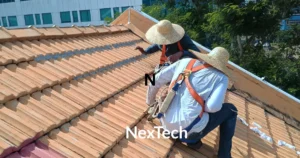
Common on terrace houses in Serangoon Garden Estate and the older bungalow stock near Dunearn Road, pitched tile roofs fail at predictable points: slipped or cracked tiles from UV brittleness, degraded felt or bituminous underlayment beneath the tiles, and open joints at ridges and valleys where water concentrates during heavy downpours.
Diagnostic: We walk the roof (or use a drone on steep GCB pitches) checking tile alignment, cracking, and moss growth that traps moisture. Underneath, thermal imaging picks up the moisture trail long before a ceiling stain appears — this is non-negotiable on a tiled roof because the leak point is almost never directly above the stain; water travels along the underlayment and battens before it drops — a distinction that separates the useful waterproofing tips landed house Singapore roofers give from the guesswork a handyman offers.
Repair protocol: Realign or replace cracked and slipped tiles first. Where the underlayment membrane has perished — usually 15+ years in, faster on west-facing slopes with harsher UV exposure — we strip back the affected tile run and replace the felt or bituminous underlayment before re-laying tiles.
Ridges and valleys, the highest-failure zones on any tile roof, get sealed with a torch-on bituminised membrane for a fully bonded, multi-ply system, or a high-durability liquid-applied polyurethane where torching isn’t practical (close to timber structures or in occupied areas where naked flame work needs to be avoided).
On heritage-style bungalow roofs and Dempsey-style shophouse roofs where the tile profile is irregular or discontinued, we favour the liquid PU route since it conforms to odd geometry without needing matched tile replacement.
Realistic lifespan: A proper torch-on or PU ridge/valley system, done with correct underlayment, runs 10–15 years. Tile replacement alone (without underlayment work) buys you time but isn’t waterproofing — treat it as cosmetic unless the underlayment is confirmed sound. That’s one of the waterproofing tips landed house Singapore tile-roof owners skip most often, and it’s the one that costs the most to relearn.
Metal roofing is everywhere on Bukit Timah GCBs and newer landed rebuilds around Nassim and Cluny — it’s fast to install and looks sharp, but it’s also the roof type most often let down by cheap sealant. What most contractors won’t tell you about a $200 tube of generic silicone at every screw head: it shrinks, cracks, and lets water track down the screw shank within 18 months. That’s not a metal roof problem, it’s a materials-and-labour shortcut problem.
Terrace houses with metal roof extensions in estates like Katong and Joo Chiat see the same failure pattern. These waterproofing tips landed house Singapore metal-roof owners rely on apply whether the property is a GCB or a terrace block.
Diagnostic: We check every lap joint for corrosion staining (the tell-tale rust bleed line), every screw head for sealant failure or backed-out fasteners, and the panel-to-flashing junctions at ridges, valleys, and roof penetrations — skylights, aircon ledges, antenna mounts. Corrosion at cut edges and lap joints is the earliest warning sign of a metal roof heading for trouble — spotting it early is one of the simplest waterproofing tips landed house Singapore metal-roof owners can act on themselves.
Repair protocol: Corroded sections get mechanically cleaned back to sound metal and treated with a proper anti-rust (zinc-rich or epoxy) primer before anything else touches the surface — skip this step and any topcoat you apply is just sealing rust in, not out. Lap joints and screw heads are resealed with a purpose-made butyl or polyurethane sealant rated for metal movement, not generic silicone.
Over the full panel, we apply an elastomeric acrylic or polyurea coating system that bridges hairline joints and flexes with the daily thermal expansion metal roofs go through under Singapore’s sun. Where heat gain into the roof space is also a concern — common in attic-converted bungalow roofs — we finish with a heat-reflective topcoat that measurably drops surface temperature and cuts the thermal load hitting the coating underneath, extending its working life.
Realistic lifespan: 5–10 years depending on coating system and orientation; west and north-west facing metal roofs under direct tropical sun tend to sit at the lower end and need earlier recoating.
Flat RC roof decks, roof terraces, and sandwich panel acoustic roofs — common on rebuilt semi-detached homes in Siglap, Marine Parade, and East Coast, and on flat-roof extensions around Holland Village — bring their own failure mode: ponding water. Flat means water sits, and standing water finds every crack, pinhole, and construction joint far faster than run-off ever would on a pitched roof.
Diagnostic: We map hairline and structural cracks across the slab, check falls (flat roofs should still have a minimum gradient to a drain — a genuinely dead-flat deck is a design fault waiting to leak), and run thermal imaging to trace subsurface moisture migration under the membrane, which on a concrete deck can travel metres from the actual entry point — another reason thermal imaging belongs on every serious waterproofing tips landed house Singapore checklist for flat-roof owners.
Repair protocol: Active cracks and construction joints get treated with high-pressure polyurethane resin injection — the resin is pumped in under pressure, expands on contact with moisture, and fills voids within the slab that surface coatings can never reach.
For the deck surface, we apply a cementitious waterproofing system as a rigid base layer bonded to the concrete, followed by a multi-layer reinforced PU membrane — reinforcement fabric embedded between coats is what actually gives the system tensile strength and crack-bridging ability, not just extra coating thickness.
The system finishes with a UV-resistant topcoat, since flat roofs take direct overhead sun for the longest hours of any roof type in Singapore.
Realistic lifespan: 10–15 years for a correctly specified multi-layer reinforced PU system on a sound, properly falls-graded deck. On decks with genuine ponding (no fall to drain), even the best membrane will underperform until the ponding itself is corrected — sometimes with a screed to re-establish gradient.
Terrace houses make up a large share of the landed stock in estates like Serangoon Garden, Jalan Kayu, Katong, Joo Chiat, and Frankel — and they fail differently from a detached GCB even when the roof material and membrane system are identical. The roof structure, and often the waterproofing membrane itself, runs continuously across several units, so a repair on your section can’t be treated as an isolated job the way it can on a bungalow that stands alone.
These are the same waterproofing tips landed house Singapore owners need whether the roof sits over a detached GCB or a shared terrace block — but a terrace roof adds one detail a bungalow doesn’t have: always check whether a leak is entering from your own roof or migrating in from a neighbour’s unsealed junction. Thermal imaging across the shared party wall settles this in minutes and stops you paying to reseal a section that was never the source.
Ridge and party-wall flashing on a terrace roof also needs to be treated as one continuous system, not patched unit by unit, or you’ll be back at the same junction within two years. If your terrace block sits in a conservation or heritage-fronted estate, check with your Management Corporation or neighbours before any hacking works, since a shared roof structure often needs coordinated timing even when only your unit is leaking.
The repair systems themselves — torch-on membrane, liquid PU, or reinforced multi-layer coatings — are the same ones we specify for GCB roofs. What changes on a terrace house waterproofing job is the diagnostic step and the flashing detail at party walls, which is why we always thermal-image the full shared roofline, not just the section above your ceiling stain.
Regardless of roof type, the sequence below is what separates a repair that lasts a decade from one you’ll be paying for again in three years.
These are the waterproofing tips landed house Singapore owners ask about most: how long a job will actually last, and the honest answer depends entirely on the system specified — not the brand name on the tin. As a rough, field-tested guide:
| System | Typical Lifespan | Notes |
|---|---|---|
| Single-coat liquid acrylic | 3–5 years | Fast, cheap, no reinforcement — fine as a stopgap, not a solution |
| Elastomeric acrylic/polyurea (metal roofs) | 5–10 years | Depends heavily on prep and orientation to sun |
| Torch-on bituminous membrane | 10–15 years | Best for tile roof ridges/valleys and flat decks |
| Multi-layer reinforced PU membrane | 10–15 years | Gold standard for flat concrete decks and sandwich panel roofs |
| PU resin crack injection | Structural, not a coating | Stops active leaks at cracks/joints; still needs a surface system over it |
Warning signs that mean stop DIY-ing and call a professional immediately: active dripping or a spreading ceiling stain (water has already breached the structure); bulging or blistering on a coated surface (trapped moisture beneath, coating is failing from below); rust bleed at metal lap joints or fasteners; visible structural cracks wider than a hairline on a concrete deck; ponding water that doesn’t clear within 24 hours after rain; or any repair that’s needed a touch-up more than once in 12 months. That last one is the clearest signal that the original spec — not your maintenance — was the problem.
Terrace homeowners should add one more warning sign to that list: a stain that appears near a party wall rather than the roof’s centre. That usually means water travelling in from a neighbouring unit’s junction, not your own roof.
Here are the waterproofing tips landed house Singapore owners ask us about most often, taken straight from real site visits and phone calls.
It depends on roof type, size, accessibility, and the extent of underlying damage, but as a general guide, tile roof ridge/valley resealing and PU injection crack repairs start from a few hundred dollars per affected section, while a full multi-layer reinforced PU membrane system on a flat concrete deck typically runs into the low thousands depending on square footage.
Get a proper site inspection rather than relying on a phone quote — roof condition varies too much between properties for a fair number without seeing it. Pricing is the question we get asked most, but it’s only one of the waterproofing tips landed house Singapore owners should weigh against long-term lifespan.
In many cases, yes. PU resin injection seals active cracks from within without breaking up the surrounding structure, and surface-applied membrane systems (torch-on, liquid PU, cementitious) can be built up over a properly prepared existing substrate. Hacking becomes necessary when the substrate itself is compromised — severe spalling, reinforcement corrosion, or extensive delamination — where no surface system will hold regardless of how well it’s applied. It’s one of the more nuanced waterproofing tips landed house Singapore owners need before agreeing to any hacking quote.
Realistically: 3–5 years for basic single-coat acrylic systems, 5–10 years for metal roof coating systems, and 10–15 years for correctly specified torch-on or multi-layer reinforced PU membrane systems. Anyone promising 20+ years from a single coating, regardless of roof type, is setting an expectation the material physics can’t back up in our humidity and UV exposure.
Routine repair and re-waterproofing of an existing roof generally doesn’t require BCA approval. Structural alterations — changing roof pitch, adding roof levels, or works affecting load-bearing elements — typically do, and this applies with extra scrutiny on GCBs and conservation area properties around Ridout, Nassim, and Cluny. When in doubt, check with your contractor or a qualified engineer before work starts, not after. It’s a small step, but it’s one of the waterproofing tips landed house Singapore owners on conservation-adjacent streets skip at their own risk.
Torch-on bituminous membrane is a factory-made sheet product heat-bonded to the substrate — highly consistent thickness and proven long-term performance, but it needs flat, accessible areas and open-flame work. Liquid-applied PU is spray or roller-applied on site, which makes it far better for complex geometry, tight junctions, and areas where torching isn’t practical, but its final quality depends heavily on applicator skill and correct coat thickness. Neither is universally “better” — the right choice depends on the roof geometry and site conditions.
Knowing which system fits which roof is one of the core waterproofing tips landed house Singapore owners need before they ever get a quote.
If failures are localised — one bad ridge section, a handful of corroded screw heads, a single crack — targeted repair is the right call. If you’re dealing with multiple simultaneous leak points, a membrane past 15 years old showing widespread cracking or blistering, or repairs that keep recurring within a year, you’re past the point where patching makes financial sense. At that stage a full system replacement, done properly with reinforcement and a flood test, actually costs less over a 10-year horizon than repeated patch jobs.
Recognising that tipping point early is one of the most valuable waterproofing tips landed house Singapore owners can act on before a small leak becomes a structural repair.
The materials and lifespans are the same, but the diagnostic and detailing work differs. Because terrace houses share roof structures and party walls with neighbouring units, water can migrate sideways from a neighbour’s unsealed junction before it shows up on your own ceiling — something a standalone GCB or bungalow never has to account for.
These are the waterproofing tips landed house Singapore terrace owners need most: always thermal-image the full shared roofline on a terrace job, not just the section above the stain, and treat ridge and party-wall flashing as one continuous system rather than patching unit by unit.
Search “waterproofing contractor Singapore” and you’ll find dozens of outfits promising the same five-year warranty and the same “no-hacking” pitch. Here’s what actually separates a job that lasts from one you’ll be calling about again in eighteen months — the questions we’d want answered if we were hiring a contractor for our own terrace house or GCB.
Most quotes from other waterproofing Singapore contractors are priced off a five-minute visual check of the ceiling stain. We run a full thermal imaging inspection before quoting, because on a tile roof or a terrace party wall the water almost never enters where the stain shows up. Skipping this step is how homeowners end up paying to reseal the wrong section twice.
A verbal “five-year warranty” from a landed property waterproofing Singapore contractor means nothing without a written flood-test result and product data sheets for the primer, membrane, and topcoat used. We hand over both before final payment — ask any contractor quoting you for the same, and use their answer as a filter.
Plenty of contractors who do excellent work on detached GCBs have never diagnosed a party-wall leak on a terrace house in Serangoon Garden or Joo Chiat. Ask specifically whether the quote includes thermal-imaging the full shared roofline — if a contractor doesn’t know why that matters, they haven’t done enough terrace house waterproofing work to price the job accurately.
Whether you’re comparing us against a large waterproofing contractor Singapore franchise or an independent handyman quoting a fraction of the price, the waterproofing tips landed house Singapore owners need to protect themselves are the same three questions above. Ask them before you sign, not after the first monsoon tests the answer for you.
The waterproofing tips landed house Singapore owners actually need always come back to the same principle: match the material system to the roof type, prepare the substrate properly, reinforce every seam and junction, and test before you sign off — not after the next storm finds the gap you missed.
Whether you’re maintaining a tile roof in Serangoon Garden, a metal roof on a Bukit Timah GCB, or a flat concrete deck in Siglap, the protocol doesn’t change: diagnose with thermal imaging before you hack anything open, use reinforced multi-layer systems rather than single-coat shortcuts, and get a written flood test result before you pay the final invoice.
If your leak is coming from a roof terrace or open deck rather than the main roof structure, our balcony waterproofing guide covers that scope specifically, and if you’re chasing a ceiling stain rather than a roof itself, start with our ceiling leak repair page to trace the source correctly.
For roof-specific deep dives, see our guides to metal roof waterproofing, concrete roof waterproofing, and our full landed house waterproofing overview. Book a free, no-obligation site inspection with our team and we’ll tell you honestly what your roof needs — not what’s easiest to sell.