
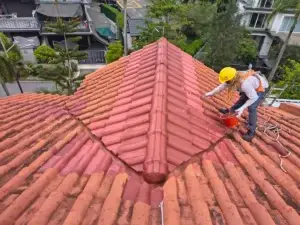
If you own a terrace house, semi-detached, or bungalow in Singapore, waterproofing is not a nice-to-have upgrade. It is the one job standing between your family and a five-figure repair bill. This waterproofing Singapore guide is built specifically for landed homeowners, covering exposed RC roofs, open-air planter boxes, party walls, and car porches that condo owners never have to think about. Read on for exactly where landed properties leak, which methods genuinely work in our climate, what they cost in 2026, and how to choose a contractor who won’t cut corners.
Unlike a condo unit tucked between other floors, your landed home has several surfaces directly exposed to the elements: a flat or pitched roof, external walls, a car porch, and often a garden or planter box. Singapore’s climate does not make this easier. According to the National Environment Agency, we receive well over 2,000mm of rain a year on average, with the Northeast Monsoon between November and January bringing the heaviest, most sustained downpours. Combine that with year-round humidity above 80 percent, and water will eventually find every hairline crack in a roof membrane, mortar joint, or wall render.
Older landed estates such as Katong, Serangoon Gardens, Changi, and parts of Bukit Timah face higher risk simply because many homes are 20 to 40 years old, built with waterproofing membranes that were never designed to last this long. This is exactly why a proper waterproofing Singapore inspection matters more as a house ages.
Not every waterproofing Singapore system suits every surface. Here is what is typically used on landed homes, and where each one belongs.
Pricing depends on surface area, accessibility, existing damage, and the material system chosen. As a general guide for landed properties:
| Area | Typical Cost Range (SGD) |
|---|---|
| Bathroom or wet area (per room) | $800 – $2,000 |
| Flat roof or roof terrace (PU membrane) | $8 – $15 per sq ft |
| Planter box waterproofing | $1,500 – $4,000 |
| Car porch or driveway | $1,200 – $3,500 |
| Crack injection (per linear metre) | $80 – $150 |
Treat this as a starting point rather than a quote. A proper site inspection is the only reliable way to know what your home actually needs, and any contractor quoting a firm price without seeing the property first should raise a flag.
Catch any of these early and you are looking at a localised repair. Ignore them through a monsoon season or two, and you are looking at rotted timber, damaged plaster, or even corroded structural steel.
A condo management office handles the roof and common areas as a shared cost across hundreds of units. As a landed owner, every membrane, joint, and coating on your property is your responsibility alone, and there’s no sinking fund to fall back on. That’s precisely why landed homeowners benefit most from a waterproofing Singapore specialist who tailors the system to their specific roof type, wall material, and drainage layout, rather than a generic, one-size-fits-all treatment.
Hardware store sealants can buy a few months on a small hairline crack. They cannot replicate a properly primed, reinforced membrane system tested to handle ponding water and constant UV exposure. For a landed home, the roof and external wall areas are too large, too exposed, and too costly to get wrong twice. Treat DIY sealant as a stopgap measure, never as the final solution.
Once you’ve shortlisted a few names, reach out for a free on-site assessment before committing to any package.
Waterproofing is not a one-time job you install and forget. Clear roof gutters and box gutters before the Northeast Monsoon arrives in November. Check planter boxes for cracked tiles or gaps in the sealant every six months. Inspect your ceilings after the first few heavy storms of the season, since that is when a failing membrane tends to show itself first. A consistent waterproofing Singapore maintenance routine costs far less than a ceiling replacement.
How long does waterproofing last in Singapore?
A properly installed PU or bituminous membrane on a flat roof typically lasts 10 to 15 years. Bathroom waterproofing under tiles can last just as long if it isn’t disturbed by later renovation work.
Can waterproofing be done during the rainy season?
Not ideally. Most membrane systems need a dry surface to cure properly, so roof and external wall work is usually scheduled outside the Northeast Monsoon months of November to January.
Do I need approval to waterproof my landed roof?
Routine waterproofing and repair work on an existing landed home generally doesn’t require separate approval, since it doesn’t alter the structure. Conservation houses, or any work that changes the roof’s structure, should be checked with your contractor and verified with URA if needed.
Is waterproofing covered by home insurance?
Most home insurance policies cover sudden, accidental water damage rather than gradual seepage caused by wear and tear or lack of maintenance. Check with your insurer directly to confirm what your policy includes.
What’s the best waterproofing method for a flat RC roof in Singapore?
For most waterproofing Singapore projects on a flat RC roof, polyurethane liquid membrane systems are the most common choice because they are seamless, flexible, and handle ponding water well, though the right system always depends on your roof’s condition and drainage.
Landed living gives you space, privacy, and a roof that’s entirely your own to protect. The homeowners who avoid expensive repairs are the ones who catch small issues early and choose proper waterproofing systems over quick fixes. If you would like a professional to assess your roof, walls, or planter boxes, Nextech Engineering provides on-site waterproofing Singapore inspections for landed homes across the island.