
If you’ve spotted a damp patch spreading across a wall after a heavy downpour, you’re dealing with water seepage from wall Singapore homes run into constantly — especially landed houses and terrace units where exposed external walls, party walls, and ageing parapets give rainwater far more ways in than a condo unit ever sees. In short: it’s moisture pushing through masonry, render, or a wall-window junction, and it almost always traces back to a specific defect rather than “just humidity.” This guide walks through what it looks like, what actually causes it in Singapore’s climate and housing stock, how to tell if it’s urgent, and what a proper fix costs.
What Does Water Seepage From Wall Singapore Homes Look Like?
Before troubleshooting causes, it helps to know what you’re actually looking at. Water seepage from wall Singapore properties typically shows up as one or more of the following:
- Dark, irregular-shaped damp patches that grow after rain and shrink (but don’t fully disappear) in dry spells
- Paint that’s bubbling, flaking, or peeling in sheets rather than small chips
- Powdery white salt deposits on the wall surface — this is efflorescence, a telltale sign moisture has been travelling through the masonry
- A musty smell in the room, particularly in corners or behind furniture pushed against the affected wall
- Plaster that sounds hollow when tapped, or render that’s soft and crumbly to the touch
Any one of these on its own might be minor. Two or three together, especially recurring after every heavy shower, usually means there’s an active entry point somewhere and it’s worth tracing before the wall structure or your ceiling below starts taking damage.
The Height Test: Where on the Wall Tells You the Likely Cause
One shortcut that’s genuinely useful before you call anyone: look at where on the wall the damp patch starts. The height gives away a lot about what’s behind it, because water travelling through masonry generally enters near where the stain begins, not somewhere far off.
| Where the damp starts | Likely cause | What usually needs checking |
|---|---|---|
| Low — near skirting or floor level | Rising damp, groundwater intrusion, or a slab/DPC (damp-proof course) failure | External ground level against the wall, drainage slope, and whether an older home ever had a damp-proof course installed |
| Mid-wall | A cracked party wall, a leaking pipe inside the wall cavity, or capillary action through hairline cracks in render | Plumbing routed through that wall, hairline cracks, and the neighbouring unit’s wall (common in terrace houses sharing a party wall) |
| High — near ceiling, parapet, or window head | Roof or parapet wall leak, a failed window lintel seal, or a gap where the window frame meets the wall | Roof membrane condition, parapet wall coping, and sealant around window frames above the stain |
This isn’t a substitute for a proper moisture-meter inspection, but it narrows things down fast — and it’s the first question any competent waterproofing contractor will ask you over the phone anyway.
What Causes Water Seepage From Walls in Singapore
Singapore’s climate doesn’t do our walls any favours — frequent, heavy rain (especially during the Northeast Monsoon between December and March) combined with intense humidity year-round means any small defect in a wall gets tested constantly. The most common causes we see on-site:
- Hairline cracks in external render — hairline cracks look cosmetic but act like a funnel during wind-driven rain
- Failed waterproofing membrane on a parapet wall, planter box, or balcony ledge that drains onto the wall below
- Deteriorated sealant around window frames, air-con sleeves, or pipe penetrations through the wall
- Rising damp from ground moisture, more common in older landed homes built before damp-proof courses were standard practice
- Poor drainage around the house perimeter, where rainwater pools against the external wall instead of running off
- Condensation mistaken for seepage, particularly in air-conditioned rooms with a large temperature difference against an external wall
Landed and terrace homes face a few extra failure points that condo owners rarely deal with. Party walls shared with a neighbouring terrace unit are a common one — if the adjoining owner hasn’t waterproofed their side, moisture can migrate through the shared wall regardless of what you do on yours. Corner terrace units take this further, since they have an extra external-facing wall exposed to wind-driven rain from a second direction. And older landed estates built in the 1970s–1990s often have render and flashing details that have simply outlived their design life, even if the home looks structurally fine otherwise.
Why Landed Homes See More Wall Seepage Than Condos
This is worth spelling out, because it changes how you should think about prevention. A condo unit typically has one or two external walls, sheltered by neighbouring units and covered corridors. A landed house or terrace unit can have three or four walls fully exposed to the elements, plus a roof, parapet, and often a garden or driveway retaining wall — each one is a separate potential entry point, and each one ages independently. It’s a big part of why water seepage from wall Singapore landed owners deal with tends to be more frequent, and more varied in cause, than what condo owners typically see.
We see this pattern most often in areas with a high concentration of landed and terrace housing. Good Class Bungalow estates around Bukit Timah, Holland Road, and Tanglin — think Chatsworth Park, Dalvey Estate, Queen Astrid Park, and the Sixth Avenue area — tend to have larger garden-facing walls and retaining structures that take a lot of direct rain exposure.
Terrace-dense estates like Serangoon Gardens, Hougang, Kovan, Punggol, and Sengkang (District 19) see a lot of party-wall seepage between adjoining units, since terrace houses there are built wall-to-wall. And the older terrace and semi-detached pockets around East Coast, Marine Parade, Joo Chiat, and Katong (District 15) often combine two risk factors at once: coastal humidity and pre-1990s construction that predates modern waterproofing standards.
If your home sits in one of these areas, it’s not a guarantee you’ll see seepage — plenty of well-maintained homes don’t — but it does mean the walls are working harder than a typical condo wall, and it’s worth a slightly more proactive inspection schedule.
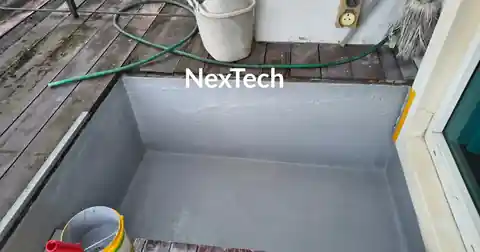
Recent Project: Wall Seepage Repair at a Singapore Landed Home
To make this less abstract, here’s a job our team handled recently. The homeowner had water seepage from a wall along their rear parapet — worst after prolonged rain, with the damp patch starting high on the wall and creeping down over a few days each time. That’s a classic “high on the wall” pattern from our height test above, and on inspection it traced back to a worn waterproofing membrane on the parapet coping that had simply reached the end of its service life.
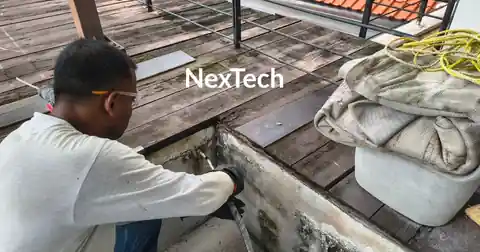
The fix involved stripping the failed coating back to a sound surface, treating the hairline cracks along the joint, and applying a fresh multi-coat waterproofing membrane rated for exposed outdoor use — the same blue basecoat you can see being rolled on below before the topcoat went on. The whole job took just under two days including drying time between coats, and the homeowner hasn’t had a recurrence through the following wet season.
Is Water Seepage From a Wall Serious?
It depends on how long it’s been left, but water seepage from wall Singapore properties experience is never something to simply paint over and ignore. Left unaddressed, seepage can:
- Weaken plaster and render, eventually causing it to detach from the wall
- Corrode embedded steel reinforcement in older concrete structures, which is a structural concern over the long term
- Create persistently damp conditions that encourage mould growth — a common trigger for musty odours and a legitimate reason to get it resolved quickly rather than masking it with paint
- Damage electrical wiring or fittings routed through or near the affected wall
- Spread to adjoining rooms or, in terrace homes, to a neighbour’s party wall
A single small patch that appeared once after an unusually heavy storm is usually low urgency — monitor it. A patch that reappears after every rain, or one that’s growing month over month, warrants a proper inspection sooner rather than later.
Quick Checks Before You Call a Contractor
A few things you can check yourself before booking an inspection — this won’t fix anything, but it’ll help you describe the problem accurately, and it’s the same checklist we run through when a water seepage from wall Singapore homeowner calls us first:
- Note whether the patch appears only after rain, or is present even during dry weeks (the latter suggests plumbing or condensation, not rainwater)
- Use the height test above to guess the likely source before the contractor arrives
- Check the external side of the affected wall for visible cracks, gaps around window frames, or a failed-looking parapet coating
- Look at the ground level outside — is water pooling against the wall instead of draining away?
- If it’s a party wall, ask your neighbour whether they’ve had any waterproofing or plumbing work done recently on their side
Avoid the temptation to just repaint over a damp patch. Fresh paint over an active leak almost always bubbles or peels again within weeks, and it wastes money that would’ve gone toward an actual fix.
When to Call a Professional
For water seepage from wall Singapore homes commonly experience, it’s worth calling a professional once you’ve confirmed it’s recurring, once it’s spread beyond a small patch, or once you’ve spotted a clear external defect (a crack, a failed membrane, or damaged flashing) that’s beyond a DIY sealant fix. A proper assessment from a specialist like wall leakage repair Singapore homeowners rely on will identify the actual entry point using moisture meters and a visual inspection, rather than guessing from the stain pattern alone.
How Long Does Wall Seepage Repair Take?
Most straightforward jobs — a single wall section with a clear, localised defect — take one to two days including drying time between coats, similar to the parapet job above, which is typical for a single-wall water seepage from wall Singapore repair. More involved repairs, like tracing a party-wall leak that requires coordinating access with a neighbour, or re-waterproofing an entire garden-facing wall on a bungalow, can run three to five days. Rising damp treatment tends to be on the longer end since it often involves injecting a damp-proof course and allowing the wall to dry out over several weeks before finishing works go on, even though the active repair itself is completed much sooner.
Water Seepage From Wall Repair Cost
Repair cost for water seepage from wall Singapore homes depends heavily on the root cause identified during inspection. Costs vary quite a bit depending on the cause, the wall area affected, and accessibility (a ground-floor wall is cheaper to work on than a wall requiring scaffolding).
A localised crack repair and re-coat might run a few hundred dollars, while a full parapet or garden wall re-waterproofing job — like the recent project above — typically costs more, and rising damp treatment with damp-proof course injection sits at the higher end given the specialised materials and labour involved. The only way to get an accurate number is a site visit, since two walls with the same symptom can have very different underlying causes. For a detailed breakdown by repair type, see our wall leakage repair Singapore guide.
Frequently Asked Questions
Can I fix water seepage from a wall myself?
Small, clearly localised issues — like a gap around a window frame — can sometimes be sealed with an exterior-grade sealant as a temporary measure. But if the patch keeps returning, DIY sealant is treating the symptom, not the source, and you’ll likely be back to square one after the next heavy rain. For anything beyond a pinhole gap, professionally repairing water seepage from wall Singapore contractors handle daily is a better long-term investment than repeated DIY patching.
How do I know if it’s seepage or condensation?
Condensation tends to appear as a fine, even film of moisture on the coldest part of a wall (often behind furniture or in an air-conditioned room), and it isn’t tied to rainfall. Seepage typically follows an irregular patch shape, worsens after rain, and often comes with efflorescence or bubbling paint — condensation rarely causes either — this distinction matters because treating water seepage from wall Singapore homes have as condensation (or vice versa) means fixing the wrong problem.
Will home insurance cover water seepage damage?
It depends on your policy and the cause. Many fire/home insurance policies in Singapore cover sudden, accidental water damage (like a burst pipe) but exclude gradual seepage from wear and tear or poor maintenance — which is what most wall seepage cases turn out to be. Check your policy’s exclusions section, and consider addressing the defect promptly since delayed repairs are the scenario insurers are most likely to decline, which is another reason to treat water seepage from wall Singapore homeowners notice as something to fix quickly rather than watch.
Does repainting stop water seepage?
No — regular paint isn’t a waterproofing layer. It might hide a stain for a few weeks, but if the underlying entry point isn’t sealed, the moisture will find its way through again, usually causing the new paint to bubble or peel faster than before — which is why repainting alone rarely resolves water seepage from wall Singapore homeowners are dealing with.
My neighbour’s terrace wall might be causing my seepage — what can I do?
Party wall issues in terrace housing are common and usually need a conversation with your neighbour, since the source of the moisture may originate on their side. A contractor can inspect both sides (with the neighbour’s permission) to confirm where the defect actually is, since resolving water seepage from wall Singapore terrace properties share often requires both sides to act, before recommending who needs to carry out the repair.
How often should landed homeowners inspect their walls for seepage risk?
Once a year is a reasonable baseline, ideally just before the Northeast Monsoon season from around November. Homes over 20 years old, or those in coastal or terrace-dense estates, benefit from a slightly closer eye — a quick visual check of parapets, render, and window sealant every six months catches small defects before it develops into the kind of water seepage from wall Singapore homeowners often only notice once the damage has already spread.
Spotted water seepage from a wall in your home? Our team inspects landed homes, terrace houses, and condo units across Singapore and can trace the exact entry point before recommending a fix. Get a free inspection and we’ll walk you through what we find.